Quick Summary
- Texas Hold’em is the ideal entry point — 2 hole cards, 5 community cards
- There are 10 hand rankings, and most pots at low stakes are won with one pair or better
- Tight-aggressive (TAG) play — ~15–20% of starting hands — beats loose play at micro stakes
- Bankroll: 20–30 buy-ins for cash games, 50–100 for tournaments
- Micro-stakes games (NL2) let you learn for almost nothing
- Position matters: the button wins more pots than the blinds
Table of Contents
- Why Learn Online Poker in 2026
- Poker Rules in 5 Minutes
- Hand Rankings: What Beats What
- Position & Table Dynamics
- Tight-Aggressive Strategy for Beginners
- Bankroll Management for Poker
- Stakes, Limits & Buy-Ins
- 7 Beginner Mistakes to Avoid
- How to Choose Your First Poker Room
- Pros & Cons of Online Poker
- Frequently Asked Questions
- Conclusion
Why Learn Online Poker in 2026
Online poker has never been more accessible: in 2026 thousands of cash-game tables run around the clock, with stakes from fractions of a cent to thousands of dollars per hand.
For a beginner, online poker beats a live casino as a classroom: start at the lowest stakes, play as many hands as you want, no dealer pressure. The rules are identical online and offline; the difference is convenience, cost, and speed.
This guide covers everything a first-time player needs — rules, hand rankings, positions, starting strategy, bankroll rules, and picking your first room.
Poker Rules in 5 Minutes
The game to learn first is No-Limit Texas Hold’em, the default format on virtually every poker site and in every major tournament. The entire rule set in condensed form:
- Each player receives 2 private cards (hole cards); five community cards are dealt face-up in the center.
- The best 5-card hand you can make from your 2 hole cards and the 5 community cards wins the pot.
- Two players post mandatory bets (blinds) before each hand; the dealer button rotates clockwise.
- On every betting round you may fold (give up), check (pass), call (match a bet), bet/raise (increase the stake), or go all-in.
- If two or more players remain after the final round, cards are revealed at the showdown and the best hand takes the pot.
Play proceeds through four betting rounds — preflop, flop, turn, river — with action starting left of the big blind and a showdown after the river. That is all the structure there is; poker’s depth comes from decisions: which hands to play, how much to bet, and when to fold.
Hand Rankings: What Beats What
Before your first hand, memorize the ten hand rankings — from weakest to strongest:
| Rank | Hand | Approx. Odds |
|---|---|---|
| 1 | High Card | 1 in 2 |
| 2 | One Pair | 1 in 2.4 |
| 3 | Two Pair | 1 in 21 |
| 4 | Three of a Kind | 1 in 47 |
| 5 | Straight | 1 in 254 |
| 6 | Flush | 1 in 509 |
| 7 | Full House | 1 in 694 |
| 8 | Four of a Kind | 1 in 4,165 |
| 9 | Straight Flush | 1 in 72,193 |
| 10 | Royal Flush | 1 in 649,740 |
Two practical notes: you always compare five-card hands (a higher kicker decides between equal pairs), and rare hands are overestimated — at micro stakes most showdowns are won with one pair or less, so fundamentals beat flashy plays.
Position & Table Dynamics
Your position — where you sit relative to the dealer button — is one of poker’s most underrated edges. The button acts last on every street, seeing everyone’s decisions first; the blinds act first postflop, and the player left of the big blind (under the gun) acts first preflop — the worst spot.
From worst to best: UTG, middle position, hijack, cutoff, button. Rule of thumb: play tighter from early positions, looser from late — the stronger your position, the more hands you can profitably enter.
Tight-Aggressive Strategy for Beginners
The best strategy for a new player is tight-aggressive (TAG): play fewer hands, but play them actively — folding most hands preflop, and betting or raising rather than limping or calling when you do enter.
A simple preflop chart for full-ring (9-handed) games:
| Position | Playable Starting Hands |
|---|---|
| Early (UTG, MP) | AA, KK, QQ, JJ, AK, AQ |
| Middle (HJ, CO) | All of the above + TT, 99, AJ, KQ |
| Late (Button) | All of the above + 22–88, any suited Ace, suited connectors (54s+) |
| Blinds | Call cheap raises with pairs and suited connectors; defend your big blind |
Postflop, keep three rules in mind:
- Bet when you have it — top pair or better is worth a value bet.
- Fold when you don’t — missed the flop and face a bet? Let it go.
- Don’t bluff at micro stakes — beginners call too much; bluffs into calling stations waste money.
Pro Tip: For your first month, play only from the button, cutoff, and hijack. Folding ~70% of hands is correct, not boring — disciplined folding is how winning players are made.
Bankroll Management for Poker
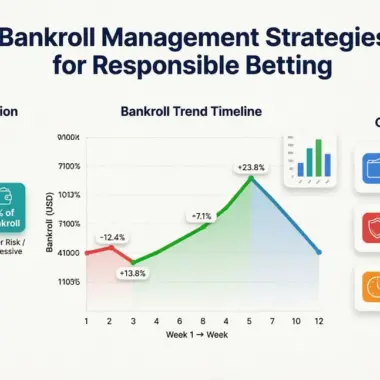
Poker is a game of skill with short-term luck (variance) — play perfectly and you can still lose several sessions in a row. Your bankroll, not your strategy, determines whether you survive.
The standard rules for beginners:
- Cash games: 20–30 buy-ins minimum — at NL10 (a $10 buy-in) that’s a $200–$300 bankroll.
- Tournaments: 50–100 buy-ins, because tournament swings are far larger.
- Never play with money you can’t afford to lose — poker funds stay separate from rent and savings.
- Move down if you lose 10 buy-ins; move up only with 30 buy-ins for the next level.
For a deeper framework, see our complete guide to bankroll management.
Stakes, Limits & Buy-Ins
Online rooms label cash games by the big blind. Typical levels for beginners:
| Game | Blinds | Buy-In (100 BB) | Bankroll Needed (25 BI) | Skill Level |
|---|---|---|---|---|
| NL2 | $0.01/$0.02 | $2 | $50 | Complete beginner |
| NL5 | $0.02/$0.05 | $5 | $125 | Beginner |
| NL10 | $0.05/$0.10 | $10 | $250 | Beginner–intermediate |
| NL25 | $0.10/$0.25 | $25 | $625 | Intermediate |
| NL100 | $0.50/$1.00 | $100 | $2,500 | Advanced |
Beyond No-Limit Hold’em you’ll find Fixed-Limit and Pot-Limit games, most commonly Omaha. For your first months, stick to NLHE at NL2–NL10 — the fundamentals transfer to every format later.
7 Beginner Mistakes to Avoid
- Playing too many hands. New players love seeing flops — stick to your starting chart.
- Calling too much. Passive calling leaks money; bet and raise instead.
- Chasing draws without odds. A flush draw needs ~4:1 pot odds — otherwise fold.
- Not folding beaten hands. A big river raise usually means what it looks like.
- Playing on tilt. After a bad beat, take a break. Emotional decisions are expensive.
- Ignoring position. Entering pots from early position with weak hands is the fastest way to lose.
- Moving up too fast. One winning session at higher stakes isn’t a reason to stay there.
How to Choose Your First Poker Room
Your first room should be licensed, trustworthy, and comfortable to use. The four things that matter most for a beginner:
- Regulation: a valid license from a recognized authority — see the best online casinos in the US and best online casinos in Europe for vetted operators.
- Low stakes and traffic: you need NL2–NL10 games running at all hours.
- Honest bonus terms: welcome offers are common, but always read the wagering requirements before claiming one.
- Fast, cheap withdrawals: some rooms pay out in minutes via crypto; others take days via bank transfer.
Before depositing real money, practice risk-free via no-deposit bonuses and freerolls. Casino bonuses can build an initial bankroll — just never let one push you above your bankroll.
Pros & Cons of Online Poker
✅ Pros
- Low entry cost — $20–$50 starts you at micro stakes
- Play anywhere — desktop, browser, or mobile app
- High learning volume — hundreds of hands per hour with stats
- Anonymous field — strangers, not friends who know your tells
- Bonuses and rewards — welcome packages, rakeback, freerolls
❌ Cons
- Variance is real — even good players have long losing stretches
- No live reads — you can’t see opponents’ body language
- Grinding takes time — micro-stakes profits are dollars per hour
- Multi-tabling temptation — too many tables hurt a beginner’s decisions
- Game quality varies — some rooms are full of tough regulars; choose your pool
Frequently Asked Questions
Is online poker legal?
In most regulated markets, yes — in the US it depends on your state, and in Europe most countries license operators directly. Check your local law first.
Can beginners actually win money at online poker?
Yes, but modestly. At micro stakes, a disciplined TAG player can be profitable — though NL2 hourly rates are small. Treat early results as practice, not income.
What is the best poker variant for beginners?
No-Limit Texas Hold’em, by far. It has the simplest rules, the most learning material, and the largest player pools at every stake.
How long does it take to learn poker?
The rules take an hour; a working TAG strategy takes a few weeks of regular play; real mastery takes months to years.
How much money do I need to start playing?
$20–$50 is enough to try NL2–NL5 with proper bankroll discipline. To stay free, start with no-deposit offers and freerolls.
Is poker a form of gambling?
Poker is a skill game played with money, and short-term results involve luck. Play only with money you can afford to lose, and treat it as entertainment first.
Conclusion
Online poker rewards patience, discipline, and study — and in 2026 it has never been easier to start. Learn the hand rankings, play tight-aggressive, respect your bankroll, start at the lowest stakes, and remember: the players who fold the most often win the most.
Your next step: pick a licensed room, claim a sensible bonus, and play a few hundred NL2 hands with your starting chart open. For the money framework that saves more than any tip, read our bankroll management guide.
Last updated: August 2026 | Always verify terms before depositing. Gambling should be entertainment, not a way to make money.