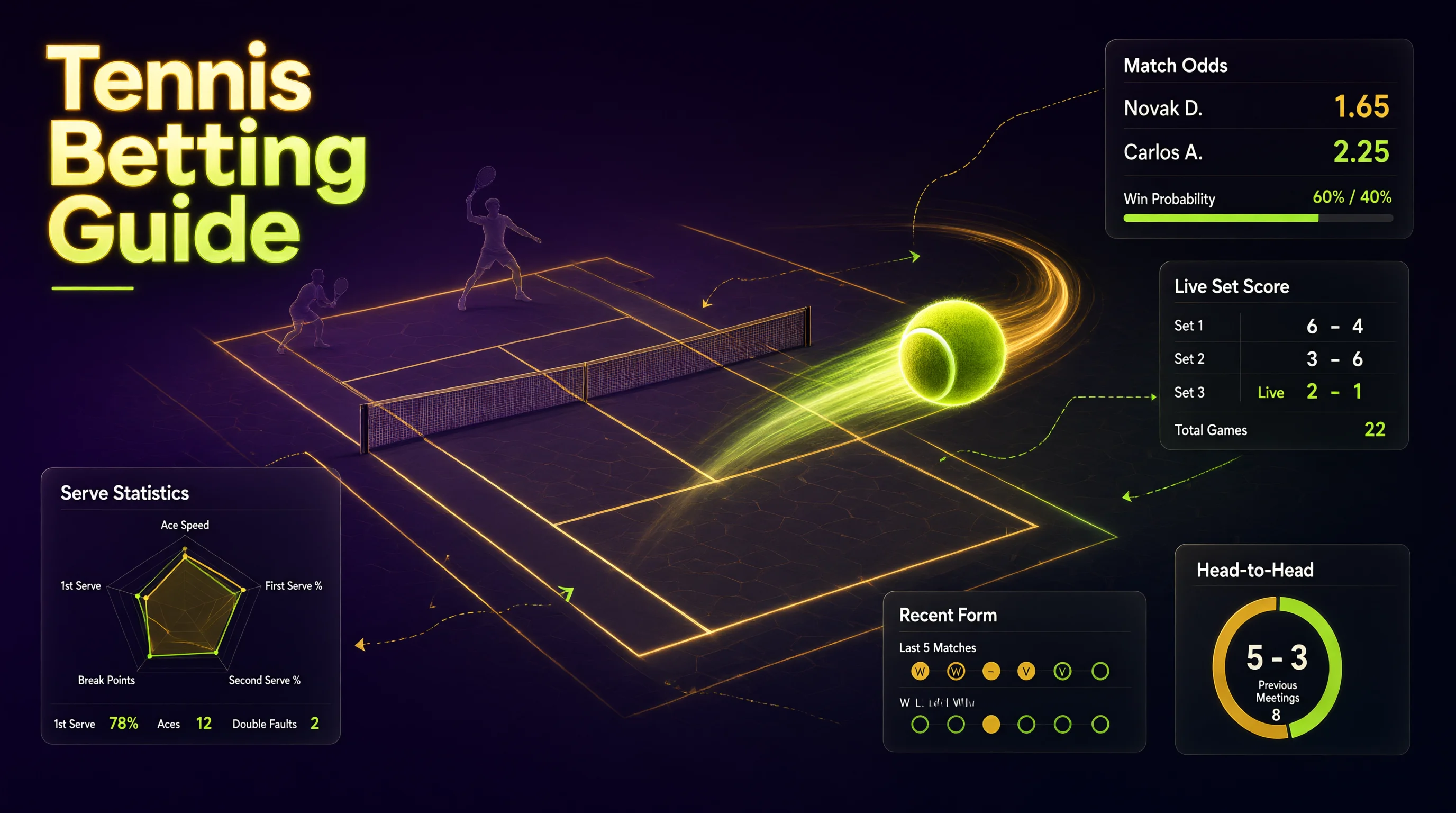

Quick Summary
- Tennis is a two-player market with no draw — the moneyline is clean and easy to model
- Serve advantage makes break points the most valuable moments in live betting
- Surface matters: clay, grass and hard courts reward different player profiles
- Set betting and correct-score markets carry high margins — use them sparingly
- Fitness, schedule and travel are underrated inputs in ATP and WTA events
- Live betting is where tennis edges are most accessible, but also where discipline matters most
Table of Contents
- Why Tennis Is a Bettor-Friendly Sport
- Match Winner Betting Explained
- Set Betting and Correct Score
- Handicaps and Total Games
- Surface and Player Profiles
- In-Play Tennis Betting
- Fitness, Schedule and Motivation
- Building a Tennis Betting Model
- Bankroll Rules for Tennis
- Frequently Asked Questions
- Conclusion
Why Tennis Is a Bettor-Friendly Sport
Tennis has several structural advantages for bettors. It is an individual sport, so there are no teammates to blame and no coaching tactics that hide weakness. Every point is public and sequenced. Matches are played nearly every week of the year across a predictable calendar. And because there is no draw, the moneyline is a pure two-way probability.
The trade-off is that tennis markets are efficient at the top. Bookmakers have detailed serve and return data, and prices on elite players are sharp. The edges tend to appear lower down the rankings, in qualifying rounds, and in live markets where momentum shifts faster than the odds.
For a broader introduction to odds, see the BonusEdge sports betting guide.
Match Winner Betting Explained
A tennis moneyline is straightforward: pick the winner. Prices range from -1000 for a top seed against a qualifier to +400 or more for a lower-ranked player.
| Player | Decimal odds | Implied probability |
|---|---|---|
| Favorite | 1.40 | 71.4% |
| Underdog | 3.00 | 33.3% |
| Total | — | 104.7% |
The 4.7% margin is typical for a Grand Slam match. Lower-tier ITF and Challenger events often carry larger margins — sometimes 8–10% — which makes them harder to beat.
A common trap is backing big names at short prices. A -800 favorite still loses roughly one match in eight. Over a season, those losses are expensive if your stake is too large.
Set Betting and Correct Score
Set betting adds a layer: you predict the exact set score, such as 2-0 or 2-1 in a best-of-three, or 3-0, 3-1, 3-2 in a best-of-five.
These markets have high margins because the outcomes are correlated. A 2-0 favorite bet combines two conditions: winning the match and winning it in straight sets. The bookmaker prices that correlation with a cushion.
When set betting can be useful:
- A player is dominant on serve and rarely loses sets against lower-ranked opponents.
- A player is returning from injury and may fade in a long match.
- A clay specialist against a hard-court player in a best-of-five event.
For most bettors, set betting is a small-stake add-on, not a core strategy. The margin is simply too high.
Handicaps and Total Games
Game handicaps and total games markets are the tennis equivalent of spreads and totals. A -3.5 game handicap means the favorite must win by four or more games across the match.
These markets are useful when you have a view on margin rather than the winner:
| Market | Example | When to use |
|---|---|---|
| Game handicap | Favorite -3.5 | Expect a comfortable but not dominant win |
| Total games | Over/under 22.5 | Expect a long, tight match |
| Tie-break | Yes/No | Big servers with few breaks |
Totals are influenced by serve quality. Two big servers on a fast hard court can produce a match with few breaks and a high total; two defensive baseliners on clay can produce long rallies but fewer games if breaks are frequent.
Surface and Player Profiles
Surface is the most important contextual variable in tennis:
- Clay: Slower, higher bounce, rewards patience, movement and heavy topspin. Break rates are higher, serve advantage is reduced.
- Grass: Faster, lower bounce, rewards big serves, slice and aggressive first-strike tennis. Break chances are fewer.
- Hard court: Medium pace, true bounce. The most common surface and the most balanced.
- Indoor hard: Faster and more predictable, with no wind. Serve and return quality dominate.
Player surface splits are easy to find and often reveal mispricing. A player with a 60% hard-court win rate but a 45% clay win rate should be priced very differently depending on the tournament.
In-Play Tennis Betting
Tennis is one of the best sports for live betting because the game state changes constantly and the market reacts in real time. Key concepts:
- Serve holds are the baseline. A player serving at 40-0 is overwhelmingly likely to hold. The market knows this, so prices are tight.
- Break points are inflection points. A break point against serve can swing a match by 10–15% in win probability.
- Momentum is not linear. A player who wins a tight first set often starts the second set stronger, but the market may overreact.
- Physical signs matter. Limping, stretching, reduced serve speed, and body language are visible on broadcast and can precede a collapse.
The biggest live-betting mistake is chasing a short price after a favorite loses the first set. Sometimes the price is justified; often it is an overreaction. The second mistake is betting every break point. Selective, pre-planned live bets beat reactive clicking.
WagerWise has a useful primer on live betting that applies to tennis.
Fitness, Schedule and Motivation
Tennis is a physically brutal sport with a crowded calendar. Factors that often go unpriced:
- Recent match length. A player who won a five-setter two days ago may be fatigued.
- Travel and time zones. Players moving from Europe to Asia or the US face jet lag.
- Injury history. Shoulder, wrist, back and knee issues affect serve and movement.
- Motivation. Lower-tier events before a Grand Slam often see top players withdraw or cruise.
- Weather. Extreme heat and humidity affect stamina, especially in best-of-five matches.
These factors are hard to quantify, but they are often visible in press conferences, practice reports, and betting line moves.
Building a Tennis Betting Model
A simple model can be built from four inputs:
- Serve hold percentage on the relevant surface.
- Return break percentage on the relevant surface.
- Head-to-head adjustment — small, and only when recent and surface-relevant.
- Fatigue and schedule adjustment.
From there, simulate the match point by point or use a Markov chain to estimate match win probability. Compare your number to the market and bet only when the edge exceeds 4–5%.
Pro Tip: Track closing line value (CLV). If your tennis bets consistently beat the closing price, your model is adding information. If not, the market knows more than you do.
Bankroll Rules for Tennis
Tennis has frequent events and high variance. A 1–2% flat stake is a sensible default. Because many matches are best-of-three and decided by a few points, avoid large stakes on short-priced favorites.
| Bankroll | Stake per bet | Max exposure per day |
|---|---|---|
| $500 | $5–$10 | $30 |
| $2,000 | $20–$40 | $120 |
| $10,000 | $100–$200 | $600 |
For more on staking, see the BonusEdge bankroll guide.
Frequently Asked Questions
Is tennis betting profitable?
For disciplined bettors with a model or strong surface knowledge, yes. For casual bettors backing favorites, no. The margin is lower than in many sports, but it is still there.
What is the best tennis betting market?
The match winner market is the most liquid and the easiest to model. Game handicaps and totals are useful for specific views; set betting is high-margin and best used sparingly.
How does live tennis betting work?
Odds update after every point. You can bet on the match winner, set winner, next game, or correct score while the match is in progress. Prices react to score, serve, and momentum.
Do retirements affect bets?
Yes. Rules vary by bookmaker. Some void bets if a player retires, others settle based on the score at retirement. Always check the specific rules before betting.
What is the most important stat in tennis betting?
Serve hold percentage and return break percentage on the relevant surface. These two numbers explain most of a player’s match win probability.
Conclusion
Tennis rewards specialization. Learn a few players deeply, understand surface effects, and treat live betting as a planned activity rather than a reaction. The market is efficient at the top, but there are edges in the margins.
For odds conversion and stake sizing, use the BonusEdge betting calculator. For a wider strategy framework, read WagerWise on sports betting strategies.
Last updated: October 2026 | Always verify terms before depositing. Gambling should be entertainment, not a way to make money.