Quick Summary
- Provably fair is a cryptographic system that lets players verify every game result themselves — no trust in the casino required
- The system combines three inputs — server seed, client seed, and nonce — through SHA-256 hashing
- Manual verification takes under two minutes: copy three values, paste them into a verifier, compare the output
- Dice, crash, blackjack, roulette, and some slots at crypto casinos are provably fair; traditional RNG games are not
- Provably fair proves the math behind a result but does not replace licensing, regulation, or responsible gambling checks
Table of Contents
- What Does Provably Fair Mean?
- How the Cryptography Works
- How to Verify a Game Result Step by Step
- Provably Fair vs Traditional RNG Certification
- Which Games Support Provably Fair
- Pros & Cons of Provably Fair
- Frequently Asked Questions
- Conclusion
What Does Provably Fair Mean?
Provably fair describes a gambling system in which the player can mathematically verify that every game outcome was generated fairly — meaning the casino could not have manipulated the result after the bet was placed. The term emerged with the first Bitcoin casinos around 2012 and has since become the standard trust mechanism across the crypto gambling industry.
In a traditional online casino, you have no choice but to trust the operator. The casino runs a random number generator (RNG) on its servers and could silently adjust the odds or lower payout rates. Regulators audit these systems, but between audits players simply take the operator’s word. Provably fair removes that leap of faith: the method is open, the inputs are shared, and anyone can confirm every result.
The concept matters for three reasons:
- Transparency. Every bet produces a verifiable trail: the exact inputs and the exact output are recorded and re-checkable.
- Player agency. You do not need to trust the casino’s reputation — you need to trust math.
- Industry pressure. As more players verify results, casinos with fair games attract deposits, while operators without provably fair support struggle to compete.
Today, most crypto-first casinos — including well-known networks like BitStarz and Stake — offer provably fair games as a default feature. If you are new to crypto gambling, read our bitcoin and crypto casino bonuses guide first, then come back to learn how the fairness layer works.
How the Cryptography Works
The Three Inputs: Server Seed, Client Seed, and Nonce
Every provably fair result is computed from three pieces of data:
- Server seed — a long random string (typically 64 hexadecimal characters) generated by the casino. The casino shows you the SHA-256 hash of the seed before you play, but keeps the seed itself secret until the round ends.
- Client seed — a random string that you choose or generate. You can change it before every round, which is why it is sometimes called a “lucky number.”
- Nonce — a counter that increments with every bet. It ensures that identical seeds produce different results for different rounds.
How the Hash Is Computed
The casino combines the three inputs into a single string — usually formatted like serverSeed:clientSeed:nonce — and runs it through the SHA-256 hash function. The resulting 256-bit hash is converted into a number, and that number is mapped onto the game’s outcome range.
For example, a dice game converts the hash into a result between 0 and 99.99, a crash game derives the round’s multiplier from it, and blackjack uses a sequence of hashes to build the deck order before cards are dealt.
The key insight: the casino publishes the server seed hash before the round. Because SHA-256 is a one-way function, nobody — not even the casino — can work backwards from the hash to predict the seed. After the round, the casino reveals the actual seed, and you can recompute the hash to confirm that the result matches. If any input had been changed, the hash would differ and verification would fail.
Pro Tip: Always change your client seed before an important session. Since the client seed and nonce are part of the input, a fresh client seed guarantees that your results are independent of anyone else’s bets on the same server seed.
How to Verify a Game Result Step by Step
You do not need special software to verify a provably fair result. Follow these steps:
- Open the game’s verification panel. Most crypto casinos place a “Provably Fair” or “Verify” button next to the game history or inside the game rules.
- Copy your round’s data. The panel shows the server seed (revealed after the round), the client seed, and the nonce for the specific bet you want to check.
- Choose a verification tool. Use the casino’s built-in verifier or a public provably fair calculator. The casino’s own tool is usually sufficient; a third-party tool adds an extra layer of independence.
- Paste the three inputs. Enter the seeds and the nonce exactly as shown, then select the game type (dice, crash, and so on).
- Compare the output. The tool recomputes the hash and shows the expected result. If it matches the result in your game history, the round was fair. If not, contact support and consider withdrawing your balance.
- Repeat for a few rounds. One verified round is good; five verified rounds across different days is a strong signal of an honest casino.
The entire process takes less than two minutes once you know where the panel is located.
Provably Fair vs Traditional RNG Certification
| Feature | Provably Fair | Certified RNG (Traditional Casinos) |
|---|---|---|
| Who checks the result | The player, at any time | Third-party auditors (eCOGRA, iTech Labs, etc.) |
| Frequency of checks | Every single round | Periodic audits (quarterly or yearly) |
| Transparency | Full — inputs and method are public | Partial — the algorithm is a trade secret |
| Manipulation resistance | Mathematical (SHA-256 commitment) | Reliance on auditor trust and regulation |
| Player skill required | Basic copy-paste | None |
| Common at crypto casinos | Yes, standard feature | Rarely, unless the operator is also licensed |
The two approaches are not mutually exclusive — the best operators combine a provably fair algorithm with a recognized license and regular external audits. Provably fair covers the math; regulation covers the money: payment security, dispute resolution, and responsible gambling tools. Our lists of best online casinos in the US and best online casinos in Europe note which operators offer verifiable games.
Which Games Support Provably Fair
| Game Type | What You Can Verify | Notes |
|---|---|---|
| Dice | Exact roll result (0–99.99) | Simplest to verify; offered by nearly every crypto casino |
| Crash | Crash multiplier per round | Popular at Stake-style platforms |
| Slots | Symbol combination per spin | Fewer crypto slots are provably fair than dice or crash |
| Blackjack | Deck order and dealt cards | Confirms no card was swapped mid-hand |
| Roulette | Winning pocket | Verify the ball result for each spin |
| Lottery / Keno | Winning numbers | Straightforward hash-to-numbers mapping |
Provably fair is easiest to implement for games with simple numeric outcomes, which is why dice and crash dominate the crypto space. Slots and live dealer games are harder — live dealer rounds use real cards and wheels, so they rely on certified RNGs or video verification. Some casinos offer a hybrid: provably fair virtual games alongside a live dealer lobby.
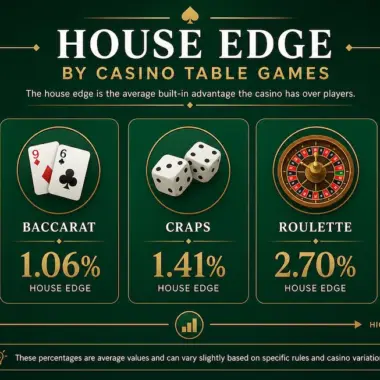
If you want to understand which games give you the best odds regardless of fairness technology, see our casino game odds and house edge guide. Provably fair tells you the game is honest; the house edge tells you what honest costs.
Pros & Cons of Provably Fair
✅ Pros
- Full transparency — every result can be verified by anyone, at any time
- No trust required — math, not reputation, guarantees fairness
- Instant verification — under two minutes per round
- Industry standard for crypto — makes operators easy to compare
- Player-friendly control — you choose your own client seed
❌ Cons
- Not a license substitute — a provably fair game can still sit on a rogue site
- Limited game coverage — many slots and live dealer games are not provably fair
- Technical barrier — many players never learn to use the verification tools
- Verifier trust — using the casino’s own tool still requires some trust
- No protection against poor odds — fairness is not the same as a good house edge
Frequently Asked Questions
Is provably fair legal?
Yes. Provably fair is a transparency technique, not a gambling mechanic. Licensed crypto casinos use it openly, and regulators generally view it favorably because it increases player protection.
Can a provably fair casino still cheat?
In theory, a casino could hide a biased algorithm behind the verification math or make verification tools hard to find. That is why you should combine provably fair checks with licensing and term reviews — our wagering requirements guide covers one more layer of terms worth inspecting.
Do I need to know programming to verify results?
No. Copying three values into a verification tool is enough. Understanding the hash math is optional.
What happens if verification fails?
Save screenshots of the inputs and the computed result, contact support, and if nothing is resolved, withdraw your balance and move on.
What is a client seed?
A random string you control, mixed with the casino’s server seed and a nonce to produce the game outcome. Change it regularly for a fresh sequence of results.
Conclusion
Provably fair is the closest thing online gambling has to an open ledger: every round can be checked, every result proven, and no operator can quietly change the odds. It has transformed crypto casinos from trust-based businesses into math-based ones — a big reason millions of players now bet with crypto without a second thought.
Still, provably fair is one piece of the puzzle. Pair it with a licensed operator, sensible bankroll management, and clear bonus terms, and you get the full package: honest math, protected money, and a sustainable budget.
Ready to try it yourself? Pick a provably fair casino from our best online casinos 2026 list, make a small deposit, and verify your first round — checking the math yourself is the whole point.
Last updated: August 2026 | Always verify terms before depositing. Gambling should be entertainment, not a way to make money.