
Quick Summary
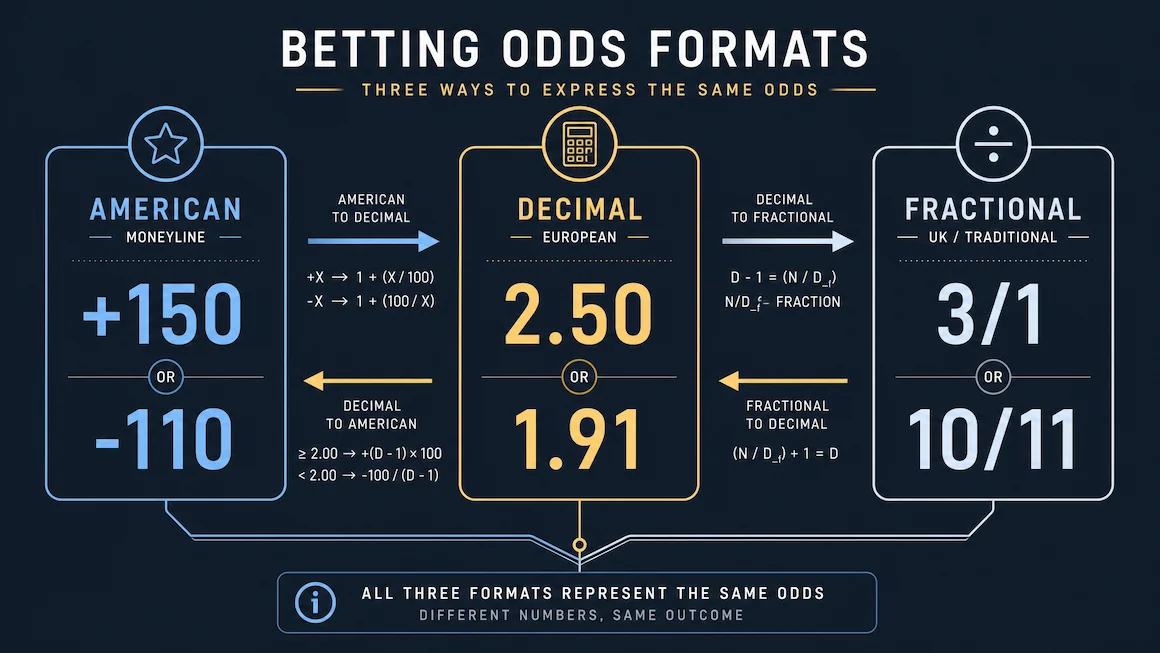
- Three main odds formats exist: American (moneyline), Decimal, and Fractional
- American odds show how much to bet ($) to win $100 (negative) or profit on $100 (positive)
- Decimal odds are the easiest to calculate returns — simply multiply your stake by the decimal number
- Fractional odds originated in UK horse racing and show profit relative to stake
- Converting between formats is simple with the right formulas — or use our Odds Converter tool
Table of Contents
- Why Understanding Odds Matters
- American Odds (Moneyline)
- Decimal Odds
- Fractional Odds
- Odds Conversion: How to Switch Between Formats
- Implied Probability: What the Odds Really Mean
- Reading Odds in Different Sports
- Frequently Asked Questions
- Conclusion
Why Understanding Odds Matters
Reading odds is the single most important skill for any sports bettor. Without it, you can’t identify value, calculate risk, or size your bets correctly.
Three reasons to master odds:
- Line shopping — Compare odds across sportsbooks to find the best price
- Value detection — Spot where bookmaker probability differs from actual probability
- Bankroll management — Calculate proper stake sizes based on odds
If you’re new to betting, start with our Complete Guide to Sports Betting for the fundamentals.
American Odds (Moneyline)
American odds are the default format in the United States. They’re displayed with a plus (+) or minus (-) sign.
Favorites: Negative Odds (-)
Negative odds show how much you need to bet to win $100.
Formula: Profit = (Stake ÷ Odds) × 100
| Odds | Stake | Profit | Total Return |
|---|---|---|---|
| -110 | $110 | $100 | $210 |
| -150 | $150 | $100 | $250 |
| -200 | $200 | $100 | $300 |
| -500 | $500 | $100 | $600 |
Example: Bets on the Kansas City Chiefs at -150 means you risk $150 to win $100 profit.
Underdogs: Positive Odds (+)
Positive odds show how much profit you make on a $100 bet.
Formula: Profit = Stake × (Odds ÷ 100)
| Odds | Stake | Profit | Total Return |
|---|---|---|---|
| +110 | $100 | $110 | $210 |
| +200 | $100 | $200 | $300 |
| +350 | $100 | $350 | $450 |
| +1000 | $100 | $1,000 | $1,100 |
Example: A bet on the underdog Titans at +350 means $100 wins you $350 profit.
The “Juice” on -110 Odds
The standard spread and over/under odds are -110. This is where the sportsbook’s commission — the vig or juice — lives.
At -110, the implied probability of each side is 52.38%. Since both sides can’t win, the total is 104.76% — the 4.76% over 100% is the bookmaker’s edge.
For a deeper comparison, see our guide on Moneyline vs Spread Betting.
Decimal Odds
Decimal odds are the standard format in Europe, Australia, Canada, and New Zealand. They’re intuitive — simply multiply your stake by the decimal number.
Formula: Total Return = Stake × Decimal Odds
| Decimal Odds | $100 Stake Return | Implied Probability |
|---|---|---|
| 1.50 | $150 | 66.67% |
| 1.91 | $191 | 52.38% |
| 2.00 | $200 | 50.00% |
| 2.50 | $250 | 40.00% |
| 3.00 | $300 | 33.33% |
| 5.00 | $500 | 20.00% |
Example: Bet $100 at decimal odds of 2.50 → Total return = $250 ($100 stake + $150 profit).
Why Decimal Odds Are Best for Beginners
- One calculation — No difference between favorites and underdogs
- Easy comparison — Higher decimal = higher payout
- Simple conversion to probability — Probability = 1 ÷ Decimal
Fractional Odds
Fractional odds are the traditional format in the UK and Ireland, especially for horse racing.
Formula: Profit = Stake × (Numerator ÷ Denominator)
| Fractional Odds | $100 Stake Profit | Decimal Equivalent | Implied Probability |
|---|---|---|---|
| 1/10 | $10 | 1.10 | 90.91% |
| 1/2 | $50 | 1.50 | 66.67% |
| 10/11 | $90.91 | 1.91 | 52.38% |
| 1/1 (Evens) | $100 | 2.00 | 50.00% |
| 3/1 | $300 | 4.00 | 25.00% |
| 10/1 | $1,000 | 11.00 | 9.09% |
Example: 5/1 means for every $1 you bet, you win $5 profit. A $50 bet at 5/1 returns $300 ($250 profit + $50 stake).
Reading “Evens” (1/1)
Also written as “EVS” — this means profit equals stake. Bet $100, win $100 profit.
Odds Conversion: How to Switch Between Formats
American to Decimal
Positive American (+):
Decimal = (American ÷ 100) + 1
Example: +300 → (300 ÷ 100) + 1 = 4.00
Negative American (-):
Decimal = (100 ÷ |American|) + 1
Example: -150 → (100 ÷ 150) + 1 = 1.667
Decimal to American
Decimal > 2.00:
American = (Decimal – 1) × 100
Example: 4.00 → (4 – 1) × 100 = +300
Decimal < 2.00:
American = -100 ÷ (Decimal – 1)
Example: 1.667 → -100 ÷ (1.667 – 1) = -150
Fractional to Decimal
Decimal = (Numerator ÷ Denominator) + 1
Example: 5/1 → (5 ÷ 1) + 1 = 6.00
Decimal to Fractional
Convert the decimal part (after subtracting 1) to its simplest fraction.
Example: 3.00 → 3.00 – 1 = 2 → 2/1
Pro Tip: Don’t do manual conversions. Bookmark our Odds Converter for instant, accurate conversion between all three formats.
Implied Probability: What the Odds Really Mean
Every odds format can be converted into an implied probability — the market’s estimate of how likely an outcome is.
Calculating Implied Probability
Decimal: Probability = (1 ÷ Decimal) × 100
| Decimal | Implied Probability |
|---|---|
| 1.50 | 66.67% |
| 2.00 | 50.00% |
| 4.00 | 25.00% |
American (Positive): Probability = 100 ÷ (Odds + 100) × 100
Example: +300 → 100 ÷ (300 + 100) = 25%
American (Negative): Probability = |Odds| ÷ (|Odds| + 100) × 100
Example: -150 → 150 ÷ (150 + 100) = 60%
Finding Value
If your calculated probability is higher than the implied probability, you’ve found positive expected value (+EV) — the foundation of profitable betting.
Example:
- Odds: +200 (implied probability 33.3%)
- Your analysis says the team has a 40% chance
- Value = 40% > 33.3% → +EV bet
Use our Betting Calculator to check expected value on any wager.
Reading Odds in Different Sports
NFL Betting Odds
Usually American format. Spreads at -110. Super Bowl futures available months in advance at long odds.
Read our featured analysis: NFL Betting Tips 2026.
NBA Betting Odds
American format dominant. Player props are now available for dozens of markets per game.
Soccer Betting Odds
Decimal format standard globally. Three-way moneyline (1-X-2), Over/Under, and both teams to score (BTTS) are the main markets.
Horse Racing Odds
Fractional format remains traditional. Each-way betting adds a place component.
Frequently Asked Questions
Which odds format is best for beginners?
Decimal odds are the easiest. One multiplication gives you total return, and comparing value is straightforward.
What does “minus” mean in odds?
Minus (-) indicates the favorite. It shows how much you need to bet to win $100. -150 means bet $150 to win $100.
What does “plus” mean in odds?
Plus (+) indicates the underdog. It shows how much profit you make on a $100 bet. +200 means bet $100 to win $200.
Why do odds change before a game?
Odds move based on betting action, injury news, weather, and sharp money. Early odds offer the most value.
What’s the difference between “odds” and “juice”?
Odds represent the potential payout. Juice (vig) is the sportsbook’s commission baked into the odds, typically around 4.76% on -110 lines.
Conclusion
Reading odds is the gateway to informed sports betting. Whether you prefer American, Decimal, or Fractional, the core concept is the same: odds reflect probability, and your job is to find discrepancies between the bookmaker’s estimate and reality.
Master these fundamentals, and you’ll be ready for advanced topics like arbitrage, line shopping, and expected value betting.
Practice with our tools: Use the Odds Converter to switch between formats, the Parlay Calculator to build multi-leg bets, and the Betting Calculator to size your stakes intelligently.
Last updated: July 2026 | Odds formats remain consistent globally. Always check which format your sportsbook uses before placing a bet.