
Quick Summary
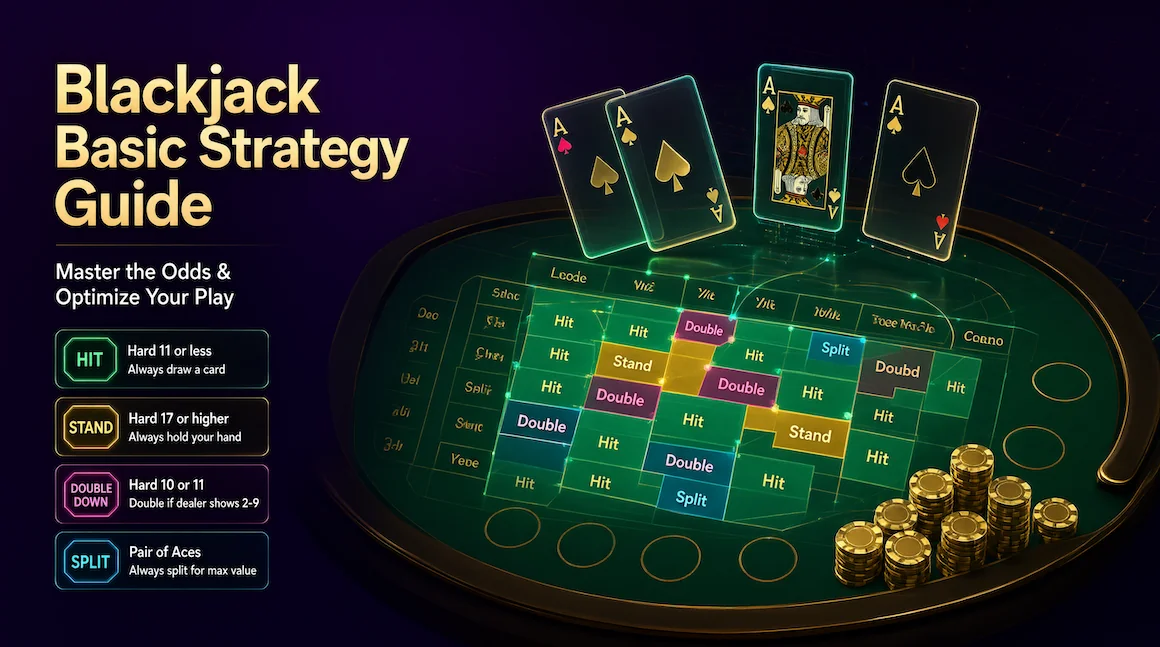
- Basic strategy is the mathematically optimal play for every blackjack hand
- It reduces the house edge to roughly 0.5% on a standard 3:2, six-deck table
- The chart changes with rules: dealer hits/stands on soft 17, double after split, surrender
- Never take insurance; it is a separate bet with a high house edge
- Blackjack pays 3:2 is non-negotiable; 6:5 tables add about 1.4% to the house edge
- Memorize the chart, then practice with a trainer before playing for money
Table of Contents
- Why Basic Strategy Matters
- The Rules That Change the Chart
- Hard Totals Chart
- Soft Totals Chart
- Pair Splitting Chart
- When to Double Down
- Insurance and Even Money
- House Edge by Rule Set
- How to Learn and Practice
- Frequently Asked Questions
- Conclusion
Why Basic Strategy Matters
Blackjack is the only major casino game where the player’s decisions affect the house edge. Slots, roulette and baccarat are fixed-odds games; blackjack is a skill game with a small edge for the house that can be reduced to near zero with correct play.
Basic strategy is a set of decision rules derived from millions of simulated hands. It tells you whether to hit, stand, double or split based on your hand and the dealer’s upcard. Following it perfectly does not guarantee a win on any hand, but it minimizes the house edge over time.
On a standard six-deck game where the dealer stands on soft 17, blackjack pays 3:2, and double after split is allowed, the house edge with basic strategy is about 0.5%. That is one of the lowest edges in the casino.
The Rules That Change the Chart
There is no single universal basic strategy chart. The correct play depends on the table rules:
| Rule | Effect |
|---|---|
| Dealer stands on soft 17 (S17) | Better for the player |
| Dealer hits soft 17 (H17) | Worse by about 0.2% |
| Blackjack pays 3:2 | Standard |
| Blackjack pays 6:5 | Worse by about 1.4% |
| Double after split (DAS) | Better by about 0.14% |
| Late surrender | Better by about 0.07% |
| Resplit aces | Better |
| No hole card | Slightly worse |
Always check the table rules before playing. A 6:5 table with otherwise good rules is still a bad game.
Hard Totals Chart
Hard totals are hands without an ace, or hands where the ace counts as one. The chart below assumes a standard S17 game with DAS.
| Your hand | 2 | 3 | 4 | 5 | 6 | 7 | 8 | 9 | 10 | A |
|---|---|---|---|---|---|---|---|---|---|---|
| 8 or less | H | H | H | H | H | H | H | H | H | H |
| 9 | H | D | D | D | D | H | H | H | H | H |
| 10 | D | D | D | D | D | D | D | D | H | H |
| 11 | D | D | D | D | D | D | D | D | D | H |
| 12 | H | H | S | S | S | H | H | H | H | H |
| 13 | S | S | S | S | S | H | H | H | H | H |
| 14 | S | S | S | S | S | H | H | H | H | H |
| 15 | S | S | S | S | S | H | H | H | H | H |
| 16 | S | S | S | S | S | H | H | H | H | H |
| 17–21 | S | S | S | S | S | S | S | S | S | S |
Key: H = hit, S = stand, D = double if allowed, otherwise hit.
A few nuances:
- 16 vs. 10 is a hit in most rule sets, but a surrender in games that offer late surrender.
- 12 vs. 4, 5, 6 is a stand; 12 vs. 2, 3 is a hit.
- 11 vs. ace is a hit in S17 games, double in some H17 games.
Soft Totals Chart
Soft totals contain an ace counted as 11. The chart below assumes S17 and DAS.
| Your hand | 2 | 3 | 4 | 5 | 6 | 7 | 8 | 9 | 10 | A |
|---|---|---|---|---|---|---|---|---|---|---|
| A,2 (13) | H | H | H | D | D | H | H | H | H | H |
| A,3 (14) | H | H | H | D | D | H | H | H | H | H |
| A,4 (15) | H | H | D | D | D | H | H | H | H | H |
| A,5 (16) | H | H | D | D | D | H | H | H | H | H |
| A,6 (17) | H | D | D | D | D | H | H | H | H | H |
| A,7 (18) | S | D | D | D | D | S | S | H | H | H |
| A,8 (19) | S | S | S | S | D | S | S | S | S | S |
| A,9 (20) | S | S | S | S | S | S | S | S | S | S |
Key: H = hit, S = stand, D = double if allowed, otherwise hit.
Soft 18 is the most misplayed hand in blackjack. Against a 2, 7 or 8, stand; against 3–6, double; against 9, 10 or ace, hit. Many players stand against everything, which costs them money.
Pair Splitting Chart
| Pair | 2 | 3 | 4 | 5 | 6 | 7 | 8 | 9 | 10 | A |
|---|---|---|---|---|---|---|---|---|---|---|
| A,A | SP | SP | SP | SP | SP | SP | SP | SP | SP | SP |
| 2,2 | SP | SP | SP | SP | SP | SP | H | H | H | H |
| 3,3 | SP | SP | SP | SP | SP | SP | H | H | H | H |
| 4,4 | H | H | H | SP | SP | H | H | H | H | H |
| 5,5 | D | D | D | D | D | D | D | D | H | H |
| 6,6 | SP | SP | SP | SP | SP | H | H | H | H | H |
| 7,7 | SP | SP | SP | SP | SP | SP | H | H | H | H |
| 8,8 | SP | SP | SP | SP | SP | SP | SP | SP | SP | SP |
| 9,9 | SP | SP | SP | SP | SP | S | SP | SP | S | S |
| 10,10 | S | S | S | S | S | S | S | S | S | S |
Key: SP = split, D = double, H = hit, S = stand.
Never split tens or fives. Always split aces and eights. Those three rules alone prevent most beginner mistakes.
When to Double Down
Doubling down means matching your original bet and receiving exactly one more card. It is profitable when your hand is strong relative to the dealer’s upcard.
Core doubling situations:
- 11 against everything except an ace in S17 games.
- 10 against 2–9.
- 9 against 3–6.
- Soft 13–18 against weak dealer upcards (3–6), depending on the exact total.
- A,7 (soft 18) against 3–6.
Doubling is where many casual players leave money on the table. If the chart says double and you only hit, you are giving up expected value on every occurrence.
Insurance and Even Money
Insurance is a side bet that the dealer has a ten-value card underneath an ace. It pays 2:1 and carries a house edge of about 5.9% in a six-deck game. Basic strategy says: never take insurance.
Even money is offered when you have blackjack and the dealer shows an ace. It is mathematically identical to taking insurance on a blackjack. Decline it unless you are counting cards and know the deck is ten-rich.
House Edge by Rule Set
| Rule set | Approx. house edge |
|---|---|
| 3:2, S17, DAS, surrender | 0.4% |
| 3:2, S17, DAS | 0.5% |
| 3:2, H17, DAS | 0.7% |
| 3:2, H17, no DAS | 0.9% |
| 6:5, S17, DAS | 1.9% |
| 6:5, H17, no DAS | 2.3% |
The difference between the best and worst tables is nearly 2% — far larger than most players realize. Table selection is a strategy decision.
How to Learn and Practice
- Memorize the hard totals first. They are the most common hands.
- Learn soft totals next. Soft 18 is the key hand.
- Learn pair splitting last. It is less frequent but high-impact.
- Practice with a free trainer until you can play 100 hands without an error.
- Play at low limits until the decisions are automatic.
- Recheck the chart for the specific rules at your table.
WagerWise’s casino game rules guide is a useful companion, and their RTP and house edge explainer covers the underlying math.
Pro Tip: Basic strategy is not about winning every hand. It is about making the least bad decision every time. Over thousands of hands, those small edges compound.
Frequently Asked Questions
Does basic strategy actually work?
Yes. It is mathematically optimal for the given rules. It does not guarantee short-term wins, but it minimizes the house edge over time.
Should I always split aces and eights?
Yes, in almost every rule set. Always split aces and eights; never split tens or fives.
Is insurance ever worth it?
Only for card counters with a strong count. For basic strategy players, insurance is a losing bet.
What is the house edge with basic strategy?
About 0.5% on a standard 3:2, six-deck, S17, DAS table. It rises with worse rules, especially 6:5 payouts.
Can I use a basic strategy card at the table?
In land-based casinos, yes, usually. Online, you can keep a chart open. Live dealers generally allow it too, but check the casino’s rules.
Conclusion
Basic strategy is the foundation of blackjack. Learn the charts, choose tables with favorable rules, and practice until the decisions are automatic. The edge is small, but it is one of the few places in a casino where skill genuinely matters.
For more on house edge and game selection, read our casino game odds guide. For bankroll planning, see WagerWise on bet sizing and risk control.
Last updated: October 2026 | Always verify terms before depositing. Gambling should be entertainment, not a way to make money.