
Quick Summary
- Cash out lets you settle a bet before the event ends, usually at a price below fair value
- The bookmaker builds a margin into every cash-out offer — sometimes 5–15%
- Cashing out is mathematically equivalent to placing a new bet at the offered price
- It is most useful for injury news, changed game states and bankroll protection
- It is most harmful when used to avoid normal variance or chase a “sure thing”
- Compare the cash-out offer to the live market price before accepting
Table of Contents
- What Is Cash Out?
- How the Cash-Out Price Is Calculated
- The Hidden Cost of Cashing Out
- When Cash Out Makes Sense
- When Cash Out Hurts You
- Cash Out vs Hedging
- Partial Cash Out
- Cash Out in Different Sports
- A Practical Decision Framework
- Frequently Asked Questions
- Conclusion
What Is Cash Out?
Cash out — also called early settlement or cash-in — allows you to close a bet before the event finishes. The bookmaker offers a value based on the current state of the event and the remaining probability of your bet winning. Accept the offer, and the bet settles immediately; decline, and it runs to completion.
The feature is popular because it offers control. A bettor who is winning can lock in profit; a bettor who is losing can salvage some stake. But control is not free. Every cash-out offer includes a margin, and that margin is usually worse than the margin on the original bet.
How the Cash-Out Price Is Calculated
The bookmaker calculates the current fair value of your bet and then applies a discount. Simplified:
- Estimate the probability that the bet will win from the current state.
- Multiply by the potential payout.
- Subtract a margin — often 5–15%.
- Offer the result as the cash-out value.
Example: you have a $100 bet at +200 (potential return $300). The event is halfway through, and the bookmaker estimates your bet has a 60% chance of winning. Fair value is 0.60 × $300 = $180. With a 10% margin, the offer might be around $162.
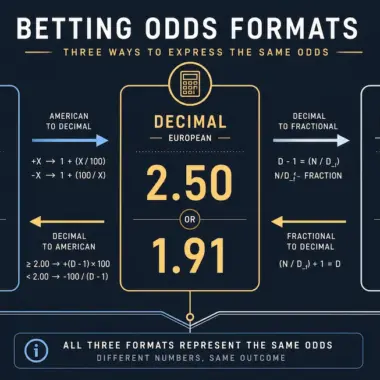
The key insight: accepting $162 is equivalent to betting $162 at odds of about 1.85 that your original bet wins. If the live market offers better than 1.85, cashing out is a bad deal.
The Hidden Cost of Cashing Out
Cash-out offers are rarely the best price available. Studies of bookmaker cash-out values consistently find that the implied margin is higher than on standard markets. That is the price you pay for convenience and certainty.
There is also a behavioral cost. Cash out encourages active decision-making during events, which increases the number of emotional, margin-paying decisions you make. Bettors who cash out frequently often end up with worse long-term results than those who let bets run.
| Scenario | Cash-out appeal | Real cost |
|---|---|---|
| Winning bet, event nearly over | High | Small in absolute terms, but margin still applies |
| Losing bet, early in event | Low | Often better to let it ride or hedge |
| Injury news after bet placed | High | Cash out may be the fastest exit |
| Emotional reaction to a swing | Very high | Usually a bad decision |
When Cash Out Makes Sense
Cash out is a tool, not a strategy. It makes sense in specific situations:
- Injury or lineup news. A key player is ruled out after you bet. The cash-out price may be the fastest way to reduce exposure.
- Changed game state. A red card, an early goal, or a weather delay materially changes the probabilities.
- Bankroll protection. If a large bet is the difference between a good month and a catastrophic one, taking a slightly worse price can be rational.
- Arbitrage or hedging. If the live market offers a better price than the cash-out, you can hedge instead — but cash out is simpler.
- Accumulators. Cash out is often used on parlays, where the final leg is uncertain. The margin is usually highest here.
When Cash Out Hurts You
Cash out is harmful when:
- You use it to avoid normal variance. A 60% favorite losing is not a reason to panic.
- You accept the first offer without comparing it to the live market.
- You cash out small profits repeatedly, paying the margin each time.
- You use it to chase losses by “saving” a bet that is already lost.
- You cash out because the event is on TV and you are emotionally engaged.
The most common pattern is the “lock in profit” trap. A bettor cashes out a $50 profit on a $10 stake, then reinvests it in another bet. Over time, the margins compound against them.
Cash Out vs Hedging
Hedging means placing an opposing bet at another bookmaker to lock in a profit or reduce risk. Cash out is a hedge offered by the same bookmaker, usually at a worse price.
| Feature | Cash out | Hedge |
|---|---|---|
| Counterparty | Same bookmaker | Another bookmaker |
| Price | Includes margin | Market price |
| Speed | Instant | Requires account and liquidity |
| Complexity | Low | Moderate |
| Best for | Convenience | Better pricing |
If you have accounts at multiple bookmakers, hedging is often cheaper than cashing out. If you do not, cash out is the practical option. WagerWise’s odds comparison guide explains how to shop live prices before settling.
Partial Cash Out
Some bookmakers allow partial cash out — you settle part of the stake and leave the rest running. This can be useful for managing risk without giving up all upside.
Example: a $100 bet at +300. You cash out $50 of the stake at the current value and leave $50 running. If the bet wins, you get a smaller payout but have already locked in some profit.
Partial cash out is generally better than full cash out for bettors who want to reduce exposure without abandoning the position. The margin still applies, but on a smaller amount.
Cash Out in Different Sports
Cash-out availability and value vary by sport:
- Soccer: Widely available; prices move quickly after goals and red cards.
- Tennis: Available on many matches; injury and momentum swings create opportunities.
- Basketball: Available on major games; live margins can be high.
- NFL: Available on most games; cash-out values are often poor on long-shot bets.
- Horse racing: Limited; cash out is less common.
- Accumulators: Often the main use case, with the highest margins.
A Practical Decision Framework
Before accepting a cash-out offer, ask:
- What is the live market price for the same outcome?
- What is the implied margin in the offer?
- Has new information arrived since I placed the bet?
- Is this decision based on analysis or emotion?
- Would I place this bet fresh at the offered price?
If the answer to question 5 is no, cashing out may still be right for risk reasons — but you should know you are paying for certainty.
Pro Tip: Treat a cash-out offer as a new bet. If you would not bet on the same outcome at the implied price, the offer is not good value.
Frequently Asked Questions
Is cash out a good idea?
Sometimes. It is useful when new information changes the bet’s value or when you need to protect bankroll. It is usually a bad idea when used to avoid normal variance or to chase losses.
Does cash out cost money?
Yes. The offer includes a margin, often 5–15%, which is higher than the margin on the original bet. You are paying for certainty and convenience.
Can I cash out a parlay?
Many bookmakers allow cash out on accumulators, often before the final leg. The margin is usually higher than on single bets.
What happens if I cash out and the bet would have won?
You receive the cash-out amount and nothing more. The potential profit is forfeited. That is the trade-off for certainty.
Is hedging better than cash out?
Often yes, if you have accounts at multiple bookmakers. Hedging at market prices is usually cheaper than accepting a cash-out margin.
Conclusion
Cash out is a convenience feature, not a profit strategy. Use it when new information genuinely changes the bet, or when bankroll protection matters more than price. Avoid it when the only reason is emotion.
For more on staking and risk, read the BonusEdge bankroll management guide and WagerWise on bet sizing and risk control.
Last updated: October 2026 | Always verify terms before depositing. Gambling should be entertainment, not a way to make money.