
Quick Summary
- MLB has no clock and no spread — the moneyline and run line are the core markets
- Starting pitchers explain most of the variance in a baseball line
- The run line is fixed at 1.5 runs; favorites win by two or more only about 30% of the time
- Home teams win roughly 53–54% of games, but park and weather effects are unusually large
- Player props are the fastest-growing MLB market, powered by daily lineup data
- Bullpen quality and lineup handedness matter as much as the starting pitcher
Table of Contents
- What Makes Baseball Betting Unique
- MLB Moneylines Explained
- The Run Line: Baseball’s Spread
- Totals and the Weather Factor
- Starting Pitchers: The Core of the Handicap
- Bullpens and Lineup Construction
- Player Props in MLB
- Park Factors and Umpire Trends
- A Repeatable MLB Betting Process
- Frequently Asked Questions
- Conclusion
What Makes Baseball Betting Unique
Baseball is the least clock-driven major sport and the most starting-pitcher-driven market. A team’s chance of winning changes dramatically depending on who takes the mound, and the market prices that in. Unlike football or basketball, there is no points spread by default — the moneyline is the primary market, with the run line as a fixed 1.5-run handicap.
The sport also has the longest season: 162 games. That means huge sample sizes, frequent back-to-backs, and a daily grind of information. Bettors who treat baseball like football — looking for a spread and a total — usually miss the most important variable: the pitching matchup.
If you need a refresher on odds formats, start with the BonusEdge odds guide.
MLB Moneylines Explained
An MLB moneyline is simply which team wins. Because baseball has no ties (extra innings settle the game), there are only two outcomes.
Typical prices range from -250 for an ace against a weak lineup to +200 for a heavy underdog. The implied probability formula is the same as any other sport: 1 / decimal odds, adjusted for the bookmaker’s margin.
| Team | Moneyline | Implied probability |
|---|---|---|
| Home favorite | -160 | 61.5% |
| Away underdog | +140 | 41.7% |
| Total | — | 103.2% |
A key MLB specific: the moneyline often moves 20–40 cents when a starting pitcher is scratched or pushed back. If you bet early, you are betting on the projected pitcher, not the confirmed one.
The Run Line: Baseball’s Spread
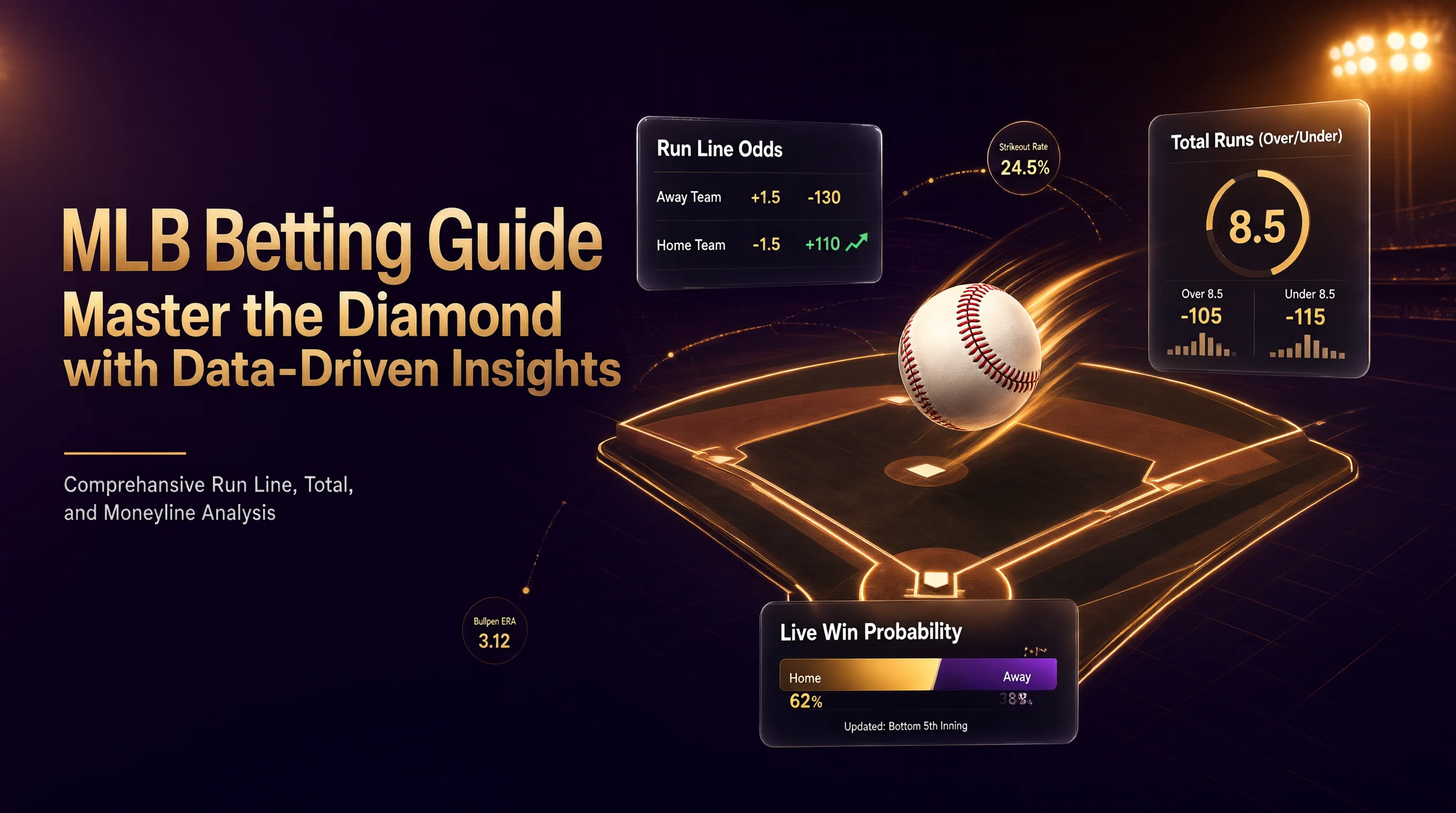
The run line is fixed at 1.5 runs. The favorite is usually -1.5 at plus money, and the underdog is +1.5 at minus money.
| Run line | Typical odds | Implied probability |
|---|---|---|
| Favorite -1.5 | +130 to +170 | 37–43% |
| Underdog +1.5 | -150 to -200 | 60–67% |
Favorites win by two or more in roughly 30% of games, which is why -1.5 pays plus money. The run line is not a coin flip on the winner; it is a bet on margin. That makes it useful when:
- A strong starter faces a weak offense and a bad bullpen.
- A team is prone to blowout wins or blowout losses.
- You want to fade a favorite whose price is too short on the moneyline.
Conversely, +1.5 on a live underdog is a common “insurance” bet — but the juice is steep, and one-run games are close to a coin flip.
Totals and the Weather Factor
MLB totals typically range from 7 to 11 runs. The number is set by park, pitchers, lineups, and weather. Weather is more important in baseball than in any other major sport:
- Wind blowing out can add 1–2 runs to a total.
- Wind blowing in can suppress scoring significantly.
- Humidity and air density affect ball flight; hot, humid air helps hitters.
- Rain delays can shorten starts and force bullpen games.
Park factors matter too. Coors Field in Denver is the extreme outlier, inflating scoring by 20–30% because of altitude. Other parks range from pitcher-friendly to hitter-friendly by 5–10%.
A practical rule: never bet a total without checking the forecast and the wind direction at first pitch.
Starting Pitchers: The Core of the Handicap
A starting pitcher’s quality affects the moneyline more than any other single factor. Key metrics:
| Metric | What it tells you |
|---|---|
| ERA | Runs allowed per nine innings — noisy over small samples |
| FIP | Fielding-independent pitching — strips out defense |
| xFIP | Expected FIP — normalizes home run rate |
| K/9 and BB/9 | Strikeout and walk rates — more stable than ERA |
| WHIP | Baserunners per inning |
| Pitch count / rest days | Workload and fatigue |
Do not judge a pitcher by wins or ERA alone. A pitcher with a 3.20 ERA but a 4.50 xFIP is likely benefiting from defense and luck. A pitcher with a 4.00 ERA but a 3.20 xFIP may be a buy-low candidate.
Also check handedness splits: some pitchers are much stronger against same-handed batters, and lineups are constructed to exploit that.
Bullpens and Lineup Construction
Modern baseball is a bullpen game. Starters average fewer than six innings, so the last three or four innings often decide the result. A team with a strong rotation but a weak bullpen is overpriced on the moneyline.
Factors to check:
- Bullpen ERA and usage over the last seven days.
- Closer availability — has he pitched three days in a row?
- Lineup handedness versus the opposing starter.
- Injuries and rest days for key hitters.
- Designated hitter rules in interleague play.
Player Props in MLB
Player props have exploded in popularity because baseball generates granular daily data. Common markets include:
- Strikeout props for starting pitchers (e.g., over/under 6.5 Ks).
- Total bases for hitters.
- Hits + runs + RBIs combos.
- Home run props at long odds.
- Pitcher outs recorded.
Props are typically priced with higher margins than moneylines — often 8–12% — so they are not automatically good value. The edge comes from information: lineup position, opposing pitcher handedness, park, weather, and recent workload.
WagerWise has a detailed explainer on value betting that applies directly to prop markets.
Park Factors and Umpire Trends
Park factors are multi-year averages of how much a stadium inflates or suppresses scoring relative to league average. They are not destiny, but they are a useful baseline.
Umpire tendencies matter for totals: some umpires have consistently larger strike zones, which suppresses walks and runs. Others are pitcher-friendly or hitter-friendly. Public umpire scorecards make this data accessible.
A Repeatable MLB Betting Process
- Confirm the starting pitchers and check for scratches.
- Review the lineups — handedness, rest, injuries.
- Check the weather — wind speed and direction, temperature, rain risk.
- Estimate a fair moneyline using pitcher quality, bullpen, lineup, and park.
- Compare to the market and only bet with a 4–5% edge.
- Size at 1–2% of bankroll.
- Track closing lines to measure your process.
For a wider betting framework, read WagerWise on sports betting strategies and bankroll management.
Pro Tip: In MLB, the best bets often come from fading public favorites with shaky bullpens. The market overreacts to a team’s recent win streak and underreacts to bullpen fatigue.
Frequently Asked Questions
Is MLB betting profitable?
It can be for bettors who specialize in pitching, weather, and park factors. The daily volume creates opportunities, but the margin is real and most bettors lose.
What is the run line in baseball?
The run line is a fixed 1.5-run handicap. The favorite must win by two or more (-1.5); the underdog covers by winning or losing by one (+1.5).
Do MLB moneylines include extra innings?
Yes. Moneylines settle after extra innings. Some derivatives, like certain totals or run lines, may have different rules — check your book.
Are player props worth betting?
Only with a specific informational edge. Props carry higher margins than moneylines, so casual betting on them is usually a losing proposition.
How important is the starting pitcher?
Extremely. A confirmed ace versus a back-end starter can move a line by 30–50 cents. Always confirm the starter before betting.
Conclusion
MLB betting is a daily research exercise. The moneyline is the core market, the run line is a margin bet, and props reward specialized knowledge. Master pitching, weather, and bullpens, and you will understand more than most of the market.
Use our betting calculator to convert odds and size bets, and see WagerWise on bet sizing and risk control for staking guidance.
Last updated: October 2026 | Always verify terms before depositing. Gambling should be entertainment, not a way to make money.