
Quick Summary
- Soccer is the deepest betting market in the world: more than 200 bet types on a single match
- 1X2 is the entry point, but Asian handicap and totals are where most sharp money sits
- Home advantage is worth roughly 0.3–0.5 goals in top European leagues — less in derbies and neutral venues
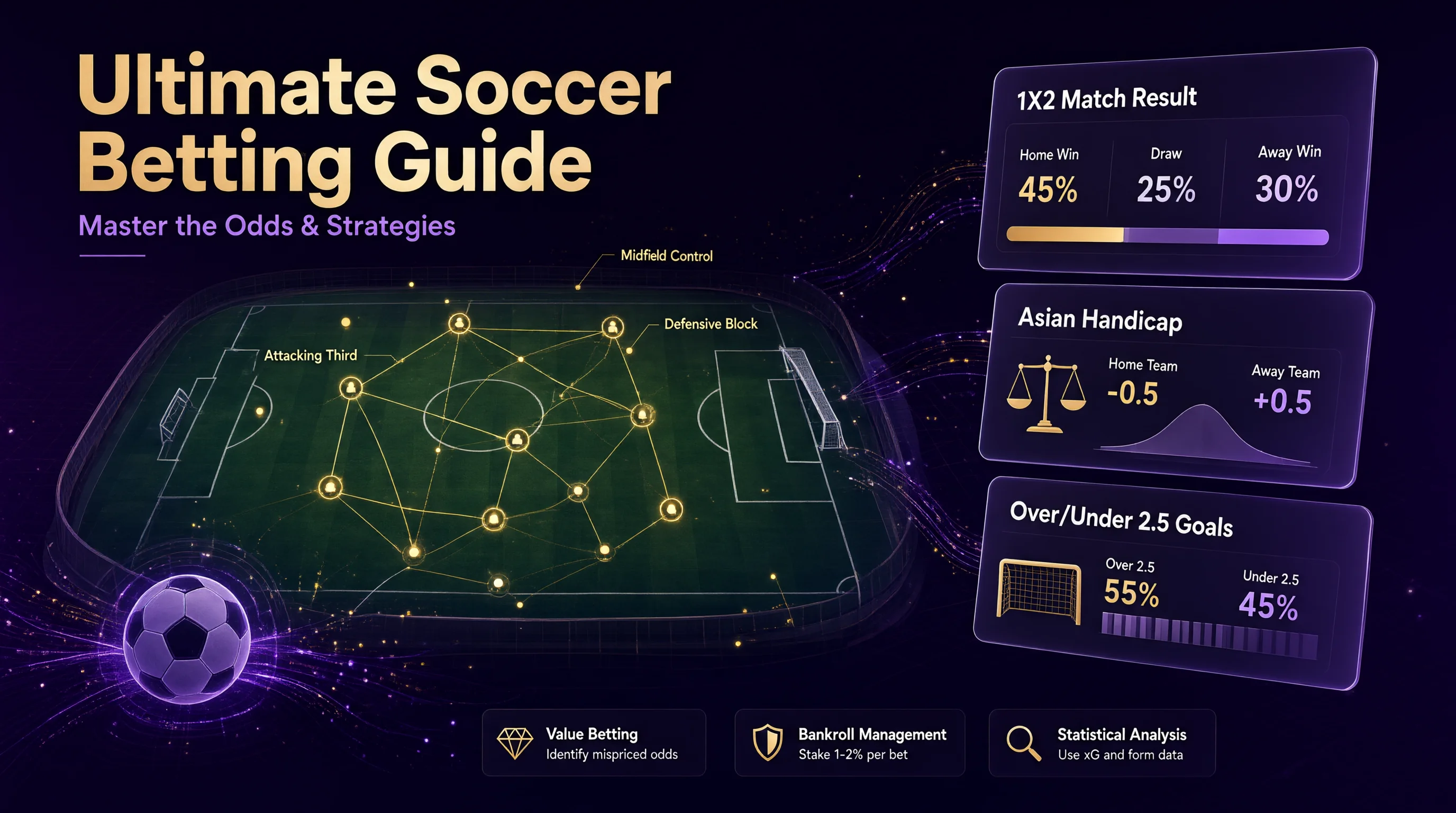
- Draws happen in about 25% of matches, which makes the draw the most mispriced 1X2 outcome
- Flat staking of 1–2% of bankroll beats chasing losses on every account that survives a full season
- Line shopping across three or more bookmakers adds more long-term profit than most tipsters
Table of Contents
- Why Soccer Betting Rewards Process Over Picks
- The Core Markets Explained
- Asian Handicap: The Market Sharp Bettors Use
- Totals and Both Teams to Score
- Reading Soccer Odds and Implied Probability
- League Trends That Matter
- A Repeatable Soccer Betting Strategy
- Bankroll Rules for a Long Season
- Seven Mistakes That Cost Soccer Bettors Money
- Frequently Asked Questions
- Conclusion
Why Soccer Betting Rewards Process Over Picks
Soccer is the most liquid sport on the planet. A single Premier League fixture can attract millions in matched bets, and bookmakers respond by pricing dozens of derivative markets: corners, cards, shots on target, player props, half-time results. The volume is attractive, but it also means the market is efficient. Beating it requires either better information, better prices, or better discipline — ideally all three.
The good news is that soccer is unusually structured. Teams play 38-match league seasons, injuries are published, tactical styles are stable over months, and historical data is abundant. Those features make repeatable analysis possible in a way that is much harder in, say, a short playoff tournament.
This guide covers the markets worth learning first, how to convert prices into probabilities, which league-level trends genuinely persist, and the staking rules that keep a bad month from ending your season. If you are completely new to odds formats, start with our complete guide to sports betting and then come back here.
The Core Markets Explained
Most soccer bettors only ever use three or four markets. That is fine — depth beats breadth. These are the ones that matter:
| Market | What you are betting on | Typical use |
|---|---|---|
| 1X2 (match result) | Home win, draw, or away win | Simple opinions, accumulators |
| Double chance | Two of three outcomes (1X, X2, 12) | Lower-risk cover for strong favorites |
| Asian handicap | Result after a virtual goal adjustment | Fair-value betting on mismatches |
| Over/Under goals | Total goals above or below a line | Style and tempo reads |
| Both teams to score (BTTS) | Whether both sides score | Attacking matchups |
| Correct score | Exact final score | Small-stake speculative bets |
| Player props | Shots, goals, assists, cards | Information edges on individuals |
Beginners gravitate to 1X2 because it is intuitive. Professionals often prefer Asian handicap because it removes the draw and reduces the bookmaker’s margin. Neither approach is wrong — but you should understand the trade-off before staking real money.
Asian Handicap: The Market Sharp Bettors Use
An Asian handicap gives one team a virtual head start or deficit. A -1 line means the favorite must win by two or more goals for the bet to land; a +1 line means the underdog covers if they lose by one or draw.
The key advantage is that Asian lines largely eliminate the draw. With a 0.0 handicap, a draw refunds your stake. With quarter lines such as -0.75, half your stake sits on -0.5 and half on -1.0, producing partial wins and losses. That sounds complicated, but it produces fairer prices: bookmaker margins on Asian handicaps are often 2–4%, compared with 5–7% on 1X2.
A practical example: Team A is priced at 1.50 to win outright (implied 66.7%). The same team at -0.5 is usually around 1.60–1.65, and at -1.0 around 1.95–2.05. If you believe the favorite wins but not comfortably, the -0.5 or 0.0 line is often better value than the straight win.
Totals and Both Teams to Score
Goals markets are driven by tempo, pressing style, and defensive structure — factors that are more stable than raw results. Two teams that both press high and leave space behind will produce over-heavy games regardless of league position.
Useful starting points:
- Over 2.5 goals lands in roughly 50–55% of matches across top European leagues, but the range by league is wide: Bundesliga and Eredivisie run hotter, Serie A and Ligue 1 cooler.
- BTTS lands in about 50% of matches on average, with strong variation by team profile.
- Late goals are real: roughly 20% of goals in top leagues arrive after the 75th minute. Live totals markets often underreact to game state.
Do not bet totals purely on a team’s last three results. Look at expected goals (xG) for and against over at least ten matches. A side creating 1.8 xG per game but scoring 0.9 is likely to regress upward — and the market may still price it as a low-scoring team.
Reading Soccer Odds and Implied Probability
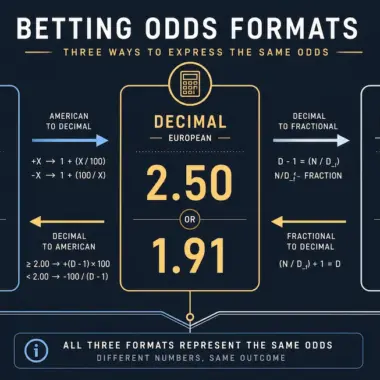
Every price contains an implied probability: implied probability = 1 / decimal odds. A 2.50 price implies 40%. Add the implied probabilities of all outcomes in a market and you get more than 100% — the excess is the bookmaker’s margin, or overround.
| Outcome | Decimal odds | Implied probability |
|---|---|---|
| Home win | 2.10 | 47.6% |
| Draw | 3.40 | 29.4% |
| Away win | 3.80 | 26.3% |
| Total | — | 103.3% |
Here the margin is 3.3%. To find fair odds, divide each implied probability by the total: the home team’s fair probability is 47.6 / 103.3 = 46.1%, or fair odds of 2.17. If another bookmaker offers 2.25, you have a genuine price edge.
If American or fractional formats confuse you, our odds conversion guide covers the math, and WagerWise has a deeper walkthrough of how to compare betting odds across books.
League Trends That Matter
League-wide patterns are useful priors, not guarantees. Three that hold up reasonably well:
- Home advantage is shrinking but still real. Top-five league home teams win about 43–46% of matches, with draw rates near 25%. In smaller leagues and cup ties, home advantage can be larger.
- Promoted teams struggle defensively early. Newly promoted sides often concede at elevated rates in the first ten matches before adjusting.
- Fixture congestion affects pressing teams. Sides that press intensely lose effectiveness when playing three matches in eight days; goals and cards tend to rise.
WagerWise breaks down betting tips by league if you want a competition-by-competition reference. Treat those trends as filters, not as standalone signals.
A Repeatable Soccer Betting Strategy
A simple process beats a complicated one:
- Pick two or three leagues. Learn the teams, managers, and referees properly.
- Model the match in goals. Estimate each team’s expected goals, then convert to match probabilities.
- Compare your number to the market. Only bet when your fair price is at least 5% shorter than the offered price.
- Check team news. Confirmed lineups move prices; betting before them is gambling on information you do not have.
- Record every bet. Stake, price, closing price, and result. Without records you cannot tell skill from variance.
- Review monthly, not daily. A 30-bet sample tells you almost nothing.
For a fuller framework, see WagerWise on sports betting strategies and value betting.
Pro Tip: The closing line is the market’s final verdict. If your bets consistently beat the closing price, you are probably doing something right even during a losing run.
Bankroll Rules for a Long Season
A soccer season is a marathon of 300+ potential bets. Survival matters more than any single weekend.
| Bankroll size | Flat stake per bet | Maximum daily exposure |
|---|---|---|
| $500 | $5–$10 (1–2%) | $30 |
| $2,000 | $20–$40 | $120 |
| $10,000 | $100–$200 | $600 |
Flat staking is deliberately boring. It prevents a hot streak from inflating stakes and a cold streak from forcing desperation bets. Kelly staking can be more efficient in theory, but it requires accurate probability estimates — something most bettors overestimate. Our bankroll management guide covers the trade-offs in detail.
Seven Mistakes That Cost Soccer Bettors Money
- Betting every match instead of waiting for an edge.
- Backing big clubs at short prices because they “always win.”
- Ignoring the draw in low-scoring matchups.
- Chasing losses with larger stakes in the same day.
- Using accumulators to turn small edges into lottery tickets.
- Betting before confirmed lineups in matches with key injuries.
- Staying with one bookmaker and accepting worse prices.
Frequently Asked Questions
Is soccer betting profitable?
For a small minority of disciplined bettors, yes. Most lose because of the bookmaker margin, poor staking, and emotional decisions. Profitability requires a genuine edge, strict records, and the ability to survive variance.
What is the safest soccer bet?
No bet is safe. Double chance and Asian handicap 0.0 reduce variance, but they do not remove risk. The “safest” approach is small stakes on well-researched value, not short prices on favorites.
How many soccer bets should I place per week?
Quality over quantity. Most successful bettors place 5–20 bets per week during a full season, concentrated in leagues they actually follow.
Do draws really happen 25% of the time?
Across top European leagues, draw rates typically sit between 23% and 28%. In tighter, lower-scoring matchups the draw probability can exceed 30%, which is why it is often underpriced.
Should I use accumulators?
Occasionally, with small stakes. Accumulators multiply both the payout and the bookmaker’s margin. Singles are better for long-term value; if you want the upside, keep accumulators to a small fraction of your bankroll. WagerWise explains the compounding risk in accumulators vs singles.
Conclusion
Soccer betting rewards preparation. Learn a handful of markets properly, convert prices into probabilities, shop lines, and stake a fixed small percentage of your bankroll. The edge will not appear every weekend — but over a full season, process beats prediction.
If you are building out your betting toolkit, pair this guide with our sports betting calculator and the bankroll management guide. For responsible-play tools, see WagerWise’s responsible gambling guide.
Last updated: October 2026 | Always verify terms before depositing. Gambling should be entertainment, not a way to make money.