
Quick Summary
- Player props are bets on an individual athlete’s stats: yards, points, shots, strikeouts and more
- Futures are season-long bets on championships, awards, divisions and playoff qualification
- Prop markets carry higher margins — often 8–12% — so information matters more than opinion
- The best prop edges come from role changes, injuries and lineup news the market has not fully priced
- Futures tie up money for months; treat them as low-stake, high-variance positions
- Records and closing lines are essential because prop samples are noisy
Table of Contents
- What Are Player Props and Futures?
- How Player Props Are Priced
- The Most Popular Prop Markets
- Where Prop Value Comes From
- Futures Betting Explained
- The Cost of Tying Up Money
- Prop and Futures Strategy
- Common Mistakes
- Frequently Asked Questions
- Conclusion
What Are Player Props and Futures?
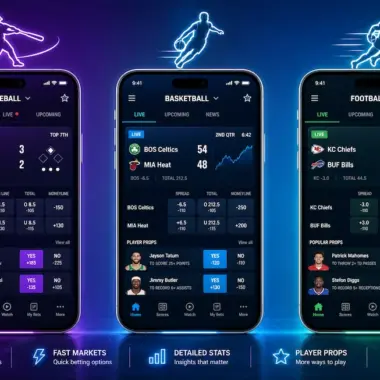
Player props — short for proposition bets — are wagers on a specific statistical outcome for an individual player. Examples include whether a quarterback will throw for over or under 275 yards, whether a basketball player will score over 25 points, or whether a soccer striker will have more than two shots on target.
Futures are long-term bets on outcomes that will be decided months later: who wins the Super Bowl, the Champions League, the NBA MVP, or which teams make the playoffs. They are popular because they offer large potential payouts for small stakes, but they also lock up capital and carry significant uncertainty.
Both markets are growing fast. In 2026, prop bets account for a large share of sportsbook handle during major events, and futures markets run year-round.
How Player Props Are Priced
Bookmakers price props using a projection model plus a margin. The projection is based on:
- Usage and role. Snap share, targets, touches, minutes, plate appearances.
- Matchup. Opposing defense, pace, park, weather.
- Recent form. Weighted toward the last 5–10 games, but not exclusively.
- Injury context. A teammate out can increase a player’s role.
The margin is then added. A fair 50/50 prop might be priced at -115/-105 or -120/+100. That 4–10% margin is the bookmaker’s edge, and it is higher than on sides and totals.
| Prop type | Typical margin | Notes |
|---|---|---|
| NFL passing yards | 6–10% | High liquidity |
| NFL anytime touchdown | 8–15% | Correlated, high margin |
| NBA points | 6–10% | Very liquid |
| Soccer shots on target | 8–12% | Lower liquidity |
| MLB strikeouts | 7–12% | Pitcher-dependent |
The Most Popular Prop Markets
NFL
- Passing yards, touchdowns and interceptions
- Rushing yards and attempts
- Receiving yards and receptions
- Anytime touchdown scorer
- Longest reception or rush
NBA
- Points, rebounds, assists
- Points + rebounds + assists combos
- Three-pointers made
- Double-doubles
- First basket
Soccer
- Anytime goalscorer
- Shots on target
- Assists
- Cards
- Passes completed
MLB
- Strikeouts for pitchers
- Total bases for hitters
- Hits + runs + RBIs
- Home runs
Tennis
- Total games
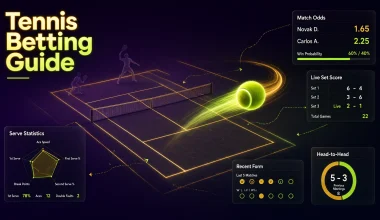
- Aces
- Double faults
Where Prop Value Comes From
Prop edges come from information asymmetry. The market prices what is known; you profit when you know something it has not fully absorbed.
Common sources of edge:
- Role changes. A receiver promoted to the WR1 role after an injury may see a target spike before the market adjusts.
- Lineup news. A point guard ruled out can raise a teammate’s assist and usage projections.
- Pace and matchup. A fast-paced opponent increases possession counts and stat opportunities.
- Weather. Wind and rain suppress passing and kicking props.
- Referee tendencies. Foul-prone crews increase free-throw and card props.
- Public bias. Casual bettors love anytime touchdown and home run props, inflating their prices.
The best prop bettors specialize. They follow one sport, one team, or one market deeply and ignore the rest.
Futures Betting Explained
Futures are season-long wagers. Common types:
- Championship futures: Super Bowl, World Series, Champions League.
- Division and conference winners.
- Award futures: MVP, Rookie of the Year, Coach of the Year.
- Playoff qualification.
- Season win totals.
Futures prices are set months in advance and move slowly. That creates opportunities when you have a strong preseason read, but it also means your money is tied up for a long time.
A useful framework is to compare the futures price to your modeled probability. If the market implies 10% and you believe the true probability is 15%, the bet has value — but only if you are comfortable with the capital lock-up.
The Cost of Tying Up Money
Futures bets can tie up funds for six to twelve months. That has an opportunity cost. A $100 futures bet at +500 that wins in June might look great, but the same $100 could have been deployed in dozens of weekly bets with a higher expected return.
Practical rules:
- Limit futures to a small percentage of bankroll — 1–5%.
- Prefer futures with shorter settlement windows when the edge is similar.
- Avoid parlaying futures with other long-term bets.
- Treat futures as entertainment positions, not core investments.
Prop and Futures Strategy
- Specialize in one sport or market.
- Build a projection model using usage, matchup and pace.
- Check late news — lineups, injuries, weather.
- Compare your projection to the line and require a 5% edge.
- Stake small — 1% or less per prop.
- Avoid correlated parlays unless you understand the correlation.
- Track results by market to see where you actually have an edge.
WagerWise’s value betting guide provides a useful framework for judging whether a prop price is genuinely off.
Pro Tip: In prop markets, the closing line is often sharper than the opening line because more information arrives during the day. Betting early on stale lines is one of the few reliable edges left.
Common Mistakes
- Betting props on players you have not watched.
- Ignoring role changes and lineup news.
- Overbetting anytime touchdown and home run props.
- Parlaying correlated props without understanding the math.
- Betting futures with too large a share of bankroll.
- Chasing a prop after a near miss.
- Assuming a player’s last game is predictive.
Frequently Asked Questions
What is a player prop bet?
A wager on an individual player’s statistical performance, such as passing yards, points, shots or strikeouts.
Are player props profitable?
They can be for specialized bettors with strong information edges. The higher margins make casual prop betting difficult to win at.
What is a futures bet?
A long-term bet on a season outcome, such as a championship, division winner or award. Futures settle months after the bet is placed.
Why do props have higher margins?
Because they are less liquid and more correlated than sides and totals. Bookmakers add a larger cushion to manage risk.
Can I parlay player props?
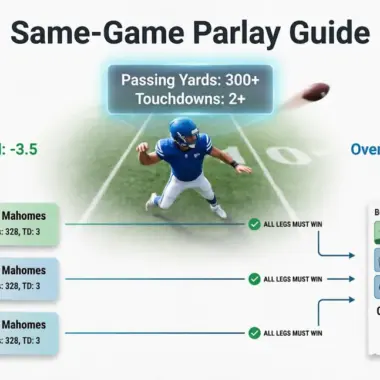
Yes, but be careful. Correlated props — like a quarterback’s passing yards and a receiver’s receiving yards — are often priced with adjusted odds or restricted by the bookmaker.
Conclusion
Props and futures are exciting markets, but they reward specialization and discipline. Pick a niche, model it properly, check late news, and stake small. The margins are higher, so the informational edge has to be real.
For odds conversion and stake sizing, use the BonusEdge betting calculator. For a broader strategy framework, read WagerWise on sports betting strategies.
Last updated: October 2026 | Always verify terms before depositing. Gambling should be entertainment, not a way to make money.